> For the complete documentation index, see [llms.txt](https://docs.erpbridge.io/llms.txt). Markdown versions of documentation pages are available by appending `.md` to page URLs; this page is available as [Markdown](https://docs.erpbridge.io/the-operation/2-database-mapping.md).
# 2 - Database Mapping
This step let you build a translation layer that permit the agent to properly retrieve data from a source and send it to the destination without the need to use the exact same database columns and HubSpot properties names.
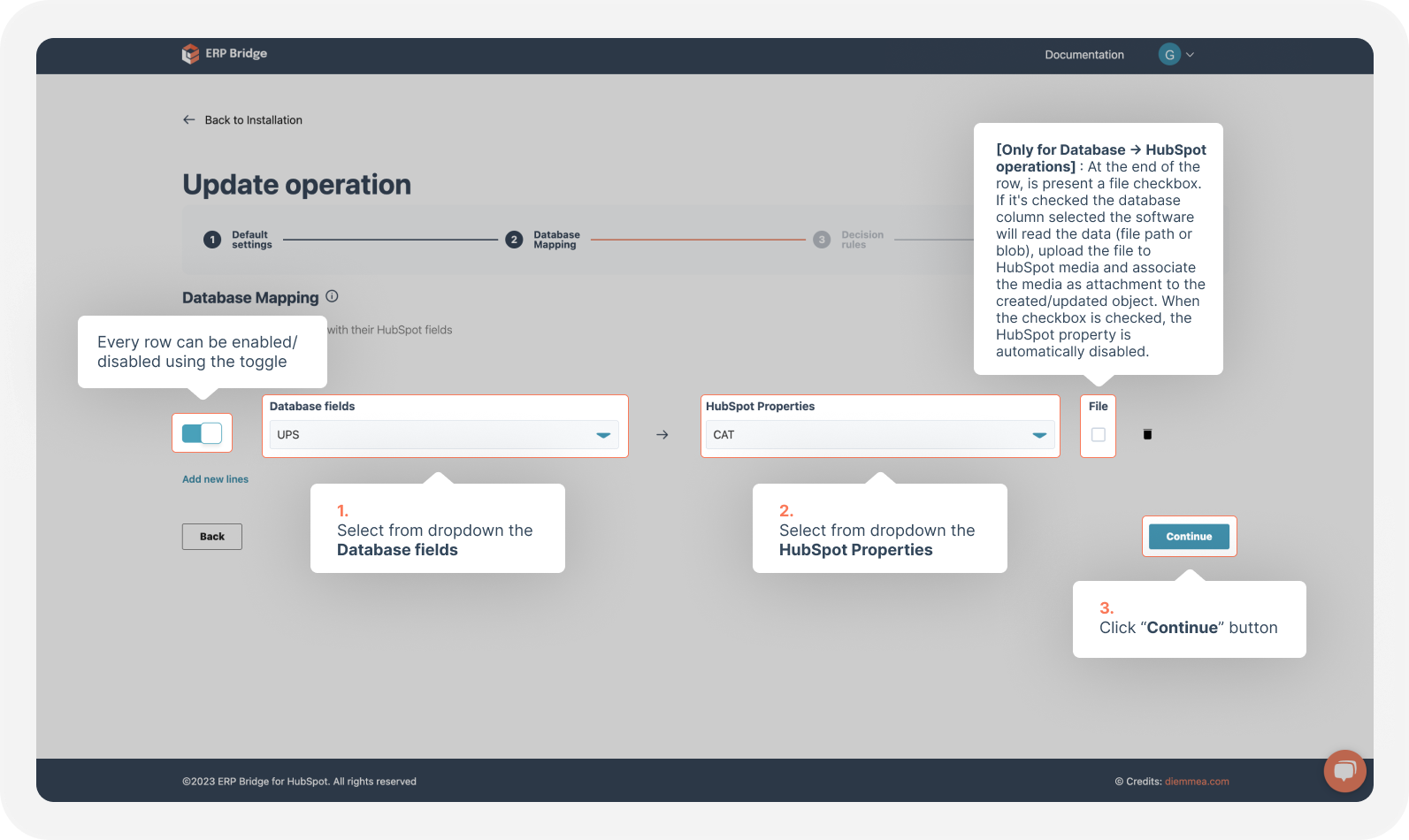
Every row can be enabled/disabled using the toggle at the start of the row. When the toggle is OFF, the specific property or database column will be ignored when the data will be sent to the destination.
The central and core drop-down menus representing the database column and the HubSpot object property.
**IMPORTANT**: In case of HubSpot Drop-Down property make sure every internal value share the same value of the database data or it will return an error when the software will try to send data to HubSpot. For instance: if you have a drop-down property with values "lorem", "ipsum", "dolor" but in the database you have a different value or the same value but with different cases (like "Lorem"), the software will not save/update that record on HubSpot at all.
**\[Only for Database -> HubSpot operations] :** At the end of the row, is present a file checkbox. If it's checked the database column selected the software will read the data (file path or blob), upload the file to HubSpot media and associate the media as attachment to the created/updated object.\
When the checkbox is checked, the HubSpot property is automatically disabled.
{% embed url="" %}
Database Mapping
{% endembed %}